Thursday

Samuels free education for all omits fair pay for adjuncts

While Samuels' analysis is persuasive, I would like to see the "fair pay" for adjuncts part! 

Would part time faculty be paid their due, that would raise higher education costs 300 billion in a ten year period, or about 30 more billion per year. 
Making All Public Higher Education Free

By Bob Samuels President, University of California-American Federation of Teachers
 Lecturer, University of California at Los Angeles January 14, 2013


 T he notion of making public higher education free is not currently “on the table” for discussion, at least in part, because the actual cost of doing so is rarely discussed. The goal of this paper is to provide an estimate of just how much it would actually cost to make all public higher education free in the United States. The “Big” Number The math is pretty simple. If we look at enrollment patterns, we find that in 2008-9, there were 6.4 million full-time equivalent undergraduate students enrolled at public universities and 4.3 million enrolled in community colleges.[i] In 2009-10, the average cost of tuition, room, and board for undergraduates at public four-year institutions was $14,870 and $7,629 for 2-year public colleges.[ii]


Multiplying the number of students in each segment of public higher education by the average total cost, we discover that the price for making all public universities free in 2009-10 would have been $95 billion and $32 billion for all community college students. Adding these two together, we arrive at a cost for making all undergraduate public higher education free in 2009-2010 of $127 billion. The Number in Context While $127 billion seems like a large figure, that number needs to be looked at in context and compared to the expenditures governments are already making on higher education. In 2010, for instance, the federal government spent $35 billion on Pell grants and $104 billion on student loans, while the states spent at least $10 billion on financial aid for universities and colleges and another $80 billion for direct support of higher education.[iii] When various state and federal approaches to offsetting tuition are taken into account, the question arises: how close could we come to making all public higher education free just by using current resources in a more effective manner? If, for instance, we eliminated the current aid system (which drives up college costs as institutions increase tuition to chase publicly-funded student aid money and to provide set aside moneys for their own student aid programs) and instead, allocated a set amount of money from state and federal governments to cover total costs for each student, we could significantly reduce the price tag of public higher education in America and come much closer to making it free. By eliminating the need for student loans, the federal government would also save billions of dollars due to the current cost of non-payment, servicing, subsidization, and defaults that could be directly applied to providing free public higher education. Tax Breaks for Higher Education Instead of directly funding public higher education institutions to cover the total costs of providing education, states and the federal government have often relied on tax deductions and credits to support individual students—in part because it is easier to pass a tax break than it is to get funding for a particular program. But ironically, this system has provided a tremendous subsidy for upper-middle-class and wealthy families, while leaving lower-income students to take out huge loans to pay for their education.[iv] In 2010/11, for example, the federal government provided the following tax subsidies, breaks, and credits for higher education: student interest rate exemption ($1.4 billion), the exclusion of employer-provided educational assistance ($1.1 billion), exclusion of interest on student-loan bonds ($0.6 billion), exclusion of scholarship and fellowship income ($3.0 billion), exclusion of tax on earnings of qualified tuition programs including savings account programs ($0.6 billion), the HOPE tax credit ($5.4 billion), the Lifetime Learning tax credit ($5.5 billion), parental personal exemption for students age 19 or over ($3.4 billion), and state prepaid tuition plans ($1.75 billion).[v]


There was also the stimulus’s American Opportunity Tax Credit ($14.4 billion), and part of the deductibility of charitable contributions (education) ($4.9 billion). In total, the federal government lost close to $40 billion in tax revenue that could have gone directly to higher education in 2010.[vi] While recent research has been done on how much the federal government has spent on tax deductions and credits for higher education, no one has examined how much states are spending on these tax breaks for colleges and universities. However, it is a safe estimate that the total subsidy by the states is at least as much as the total federal level of support since many of the states have tax deductions that exceed the national tax breaks for tuition, and most states have tax-advantaged 529 college savings plans.[vii] For example, in the state of New York, the tuition tax credit goes up to $5,000 per year per student, and the tuition tax deduction is $10,000 for each eligible student.[viii] (Once again, state tax deductions favor the wealthy since so many low-income families pay little if any federal income taxes.) 529 College Savings Plans One of the great secrets in higher education funding is the role played by 529 College Savings Plans. The money in these plans has grown significantly over the last couple of decades—from $2.6 billion in 2000 to $14 billion in 2001 to over $92 billion just five years later in 2006. “The student aid resource Finaid.org projects that total investment in 529 plans will reach $175 billion to $250 billion by 2010, with a total of 10 million to 15 million accounts opened.”[ix] Not only do state governments lose billions of dollars in tax revenue each year due to these 529 plans, but the wealthy have figured out how to use these plans as all-purpose tax shelters. For example, if a couple puts $26,000 a year for each child into an account and then later decides to use the money to buy a yacht, only the investment gains will be assessed a 10% penalty and taxed as income. Also, contributions made to a 529 are removed from a family's estate, and 529 plan owners can name a successor to the account when they die, which enables the plans to shelter money for multiple generations. Another way that wealthy people use these accounts to avoid paying taxes is by using “gifts” to fund them. Under current rules, gift taxes can be avoided if contributions into the plans over a five-year period do not exceed $65,000 for single taxpayers and $130,000 for married couples. Clearly, it is only the wealthiest Americans who are able to profit from this type of plan. And profit they can as a recent Department of the Treasury report details: since 43 states allow residents from other states to open accounts, a person could have accounts in a total of 44 states; since each state’s limit exceeds $224,465, the total an individual could legally place into these accounts is staggering.[x] Obviously, only the wealthy can afford to save and invest this type of money as the same study of 529 plans details: …among households in the top five percent of income—average income, $548,000 per year—those with education savings plans held an average balance of $106,250. That’s more than triple the average for households in the 90th-95th percentile, more than ten times the balance for the 50th-75th percentile, etc. Second, among households in Kansas who took a state income tax deduction for 529 contributions, the average deduction for households making over $250,000 per year was $10,323. For those in the $100K-$250K range it was less than $5,000, for everyone else, less than $3,000.[xi] As this federal government report indicates, 529 plans have now become an effective way to subsidize wealthy people while states are forced to cut their higher education budgets due to their lack of tax revenue. The Bottomline? If we took the state and federal money already being spent on providing higher education and the state and federal money that is lost each year due to higher education tax credits, deductions, and shelters, we could make public higher education free for millions of Americans. But this idea is simply not on the table. As we think about paying for higher education in the future, we should at least be looking at some real numbers and some real costs of our current approach. When we do, it’s hard to miss the inefficiencies and inequities in the current governmental approach to higher education. Free public higher education should, at a minimum, be up for discussion as we search for a better model. [i] U.S. Department of Education, National Center for Education Statistics, 2008, 2009, and 2008-09 Integrated Postsecondary Education Data System (IPEDS), Winter 2009-10, Spring 2009, and Fall 2009. http://nces.ed.gov/programs/digest/ d10/tables/dt10_195.asp?referrer=list. [ii]

U.S. Department of Education, National Center for Education Statistics. (2011). Digest of Education Statistics, 2010 (NCES 2011-015), Table 345. http://nces.ed.gov/fastfacts/display.asp?id=76 [iii] For statistics on Pell Grants, see Sandy Baum and Michael McPherson,“Pell Grants vs. Tuition Tax Credits.” The Chronicle of Higher Education. October 28, 2011: http://chronicle.com/blogs/innovations/pell-grants-vs-tuition-tax-credits/30663; for state spending on financial aid for higher education, see “State Support for Student Aid 2009-10.” The Chronicle of Higher Education. http://chronicle.com/article/Sortable-Table-State-Support/128153/ [iv] In fact, as shown in the study, “Moving On Up: How Tuition Tax Breaks Increasingly Favor the Upper-Middle Class,” this trend has accelerated in recent years. (Need citation) [v] The federal tax breaks for higher education are itemized at Pew Charitable Trusts, “Tax Expenditures in the Education Sector.” http://subsidyscope.org/education/tax-expenditures/ [vi] If we made all public higher education free, not only could we do away with this unjust tax system, but we could also stop the movement of public funds to expensive private and for-profit universities and colleges. What people do not notice is that the use of financial aid and tax subsidies for individual students has resulted in a system where much of the governmental support for higher education ends up going to private institutions that cater to the super-rich or to low-achieving for-profit schools. In fact, during a 2012 Congressional investigation of for-profit colleges, it was discovered that up to a quarter of all federal Pell grant money is now going to these corporate schools that charge a high tuition and graduate very few students. For statistics on how many Pell Grants for-profits colleges are using, see Andrea Fuller, “For-Profits Hit Hardest by End of Year-Round Pell Grant Program.” The Chronicle of Higher Education. June 29, 2011. http://chronicle.com/article/For-Profits-Hit-Hardest-by-End/128089/.

What this investigation did not uncover, however, was the amount of state and federal tax breaks that go to support for-profit institutions. [vii] For a list of many of the tax breaks for higher education in individual states, see FinAid, http://www.finaid.org/savings/state529deductions.phtml. [viii] The New York tuition tax deduction information can be found at: http://www.hesc.com/content.nsf/SFC/NYS_College_Tuition_Tax_CreditDeduction [ix] These statistics on 529 plans are at: http://www.finaid.org/savings/529plans.phtml [x] The Department of Treasury report on 529 plans is at: http://www.treasury.gov/resource-center/economic-policy/Documents/09092009TreasuryReportSection529.pdf. [xi] Burd, Stephen. “Moving on Up: How Tuition Tax Breaks Increasingly Favor the Upper Middle Class.” April 19 2012. http://www.educationsector.org/sites/default/files/publications/TaxCredit_CYCT_RELEASED.p

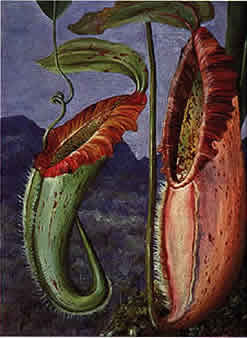
Marianne North Botanical Image (from Plant Explorers)


Marianne North was a botanical artist who travelled to six continents in the late nineteenth century to paint flowers, primarily, in their "natural habitat." She was close to the Director of Kew Gardens and her Gallery of botanical art is situated on the grounds of the Kew public gardens, in gallery space that was designed and financed by North herself. Over 630 images are displayed, along with dado samples of wood obtained from round the world. My work on Marianne North in South Africa focuses on the ways in which she was complicit with British imperial ambitions, by conveying the sense that British women could travel with ease to remote outpost without fear of danger or discomfort. This sense that women travelers would encounter a "sphere of inviolability" in southern Africa was in significant ways a falsification... she ignored the political and civil unrest in the last half of the nineteenth century: She traveled through South Africa in 1882 and 1883, as one of the last countries visited in her twenty year project, and painted, in addition to the magnificent flora of Cape Town and its environs, a rosy picture of free-wheeling unaccompanied female travelers.

The image above is one of three plants named after North, the Nepenthes northiana - a giant pitcher plant from Borneo.